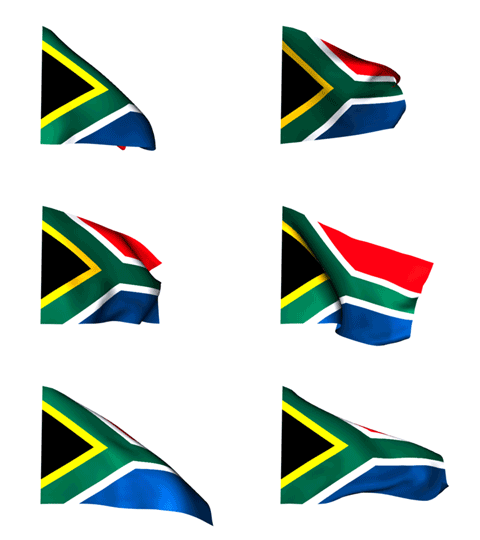
Zuid Afrika


volkslied

De geschiedenis van Zuid Afrika 

overgenomen van infoafrica.co.za


Evolution Of Man

1924

The first evidence that substantiated Darwin's theories on the evolution of man was found near Kimberley. It was the skull of a child and was classified as Australopithecus africanus, one of the very early ancestors of man.

1936

Fossils of adults of the same species were found at Sterkfontein near Johannesburg.


Origins Of The Ethnic Communities
The earliest known occupants of Southern Africa were the Khoisan, who can be divided into the San (Bushmen) and the Khoikhoi (Hottentots). The San continue their Stone Age existence relatively undisturbed until the arrival of the European traders. The Cape Khoikhoi societies however, disintegrated rapidly. Evidence has been found that Negroid communities in Natal and the Northern Province date back to AD300. In South Africa the Late Iron Age saw important changes such as the starting of metal production and towards 1400 expansion from the savannah areas to the open grasslands took place. By 1552 survivors of Portuguese shipwrecks described black settlements on the Cape and Natal coasts.

The Arrival Of The European Traders
The first documented voyages around the Cape in the late 15th century were Portuguese explorers looking for an alternate trade route to the spice islands of the East.

The Dutch Occupation

1652

6 April the Dutch East India Company sent Jan van Riebeeck to establish a half-way station at the Cape to replenish passing ships.

1657

The first free burgers start farming at Rondebosh

1658

Approximately 400 slaves were imported from West Africa

1659

First wine was pressed in the Cape

1666

Building of the Castle commences

1679

Stellenbosch is founded by Simon van der Stel

1788

The first Huguenot settlers arrived

1778

The eastern boundary of the Cape at the Fish River was declared

1781

The first British attempt to annex the Cape was made


British Annexation

1795 - 1803

The first British occupation of the Cape

1803 - 1806

The Cape was returned to the Batavian Republic

1814

Holland seceded the Cape to Britain

1820

5000 British Settlers arrived

1828

Death of the Zulu ruler Chaka

1834

Slavery was abolished

1836

The Great Trek to the interior began

1837

The Matabele were defeated by the Voortrekkers

1839

Temporary British occupation of Durban

1843

Natal was proclaimed a British colony

1844

The majority of Voortrekkers left Natal under British rule

1845

Natal separated from the Cape Colony

1847

East London was founded and British rule extended

1848

British sovereignty was proclaimed over the land between the Vaal and the Orange rivers

1852

The British recognised the independence of the Transvaal

1854

The British recognised the independence of the Orange Free State

1855

Pretoria was founded

1856

Natal was made a separate colony

1860

The first railway - a link of 3km between the Point and Port Natal comes into operation

1867

The first diamond was discovered near Hopetown

1869

Diamonds were discovered near Kimberley

1870

The diamond fields were annexed by Britain

1871

Gold was discovered at Eersteling, Pietersburg

1872

Responsible parliamentary government was granted to the Cape Colony

1873

Gold was discovered in the Lydenburg district

1877

The Transvaal was proclaimed a British territory

1878

Walvis Bay was proclaimed a British territory

1879

Zulu War - Ceteswayo was exiled and the British occupied Zululand

1880

The First War of Independence was waged in the Transvaal

1881

The Transvaal regained its independence under British sovereignty

1883

Paul Kruger became president of the South African Republic (Transvaal)

1884

Barberton gold-fields were opened. The Treaty of London granted Transvaal full independence

1886

Johannesburg was founded with the discovery of gold on the Witwatersrand

1889

Defence alliance between the Orange Free State and the Transvaal

1890

Cecil Rhodes becomes Prime Minister of the Cape Colony

1892

The railway between Cape Town and Johannesburg was completed

1893

Natal is granted self-government

1896

Rhodes resigned after the abortive Jameson Raid which attempted to overthrow the Transvaal Government

1898

Paul Kruger is elected President of the Transvaal for the 4th time

1899 - 1902

Anglo-Boer War between the two Boer republics and Britain

1902

Peace Treaty of Vereeniging. Transvaal and Orange Free State were made British colonies

1904

Death of President Kruger. Chinese labourers were imported to work on the gold mines


The Birth Of A Nation

1910

The establishment of the Union of South Africa

1912

Formation of the African National Congress (ANC)

1913

Miners strikes and riots on the Witwatersrand

1914

Grave industrial disturbances and the proclamation of martial law

1915

Conclusion of Peace with Germany (Treaty of Versailles)

1920

Strike by 71 000 black workers on the Rand. General election and a new cabinet

1922

Strike by white workers on the gold and coal mines

1924

National party with General Hertzog as Prime Minister gains power

1925

Afrikaans is recognised as the official language, parallel with English and Dutch

1930

Enfranchisement of white women

1934

South African Party and National Party fuse to form United Party

1936

Native Trust and Land Act passed

1939

Start of World War II

1943

The ANC Youth League is formed

1948

General election

1950

Group Areas Act came into operation

1956

Coloured voters were placed on a separate roll

1958

The PAC was formed

1960

Sharpeville Massacre

1961

New decimal coinage system introduced

1962

Nelson Mandela was sentenced to 5 years imprisonment

1963

Umkhonto We Sizwe headquarters raided. Nelson Mandela sentenced to life imprisonment

1966

Dr Verwoerd assassinated

1967

The first heart transplant operation was performed by Dr Chris Barnard at Grootte Schuur Hospital

1982

The Presidents Council submitted its first constitutional proposal

1983

White electorate said "yes" to proposals in a referendum

1989

Namibia gains independence from South Africa

1990

All political parties were unbanned. Negotiations began for the dismantling of Apartheid

1993

Chris Hani was assassinated

1994

Date set for elections

top van de pagina

webmaster@infoafrica.co.za
Copyright© 1996 - 2001 Info Africa All Rights Reserved.